
Checking Criminal History in Utah
Start with the kind of Utah criminal record needed. A personal fingerprint-linked repository history comes from Utah BCI through Right of Access. A public case-name search belongs in Utah Courts Xchange. Recent custody begins with the county jail, while a state sentence or adult probation and parole status belongs in UDC Offender Search. Police narratives remain with the agency that wrote them. No one source replaces the others. A person reviewing their own record should compare the BCI entry with the filing court's docket and the originating arrest report when a charge or outcome seems wrong.
Gather the full name and spelling variants, an approximate event date, the county of arrest or filing, and a case or booking number if known. Those facts help separate same-name results and narrow Xchange's 500-result ceiling. Follow this order:
- Identify whether the target is an arrest report, booking, court file, BCI history, warrant, custody record, or registry listing.
- Use the matching statewide source when one exists, then note its exclusions and update limits.
- Choose the county that created the arrest, jail, or court record and open its local records site.
- Compare several identifiers and read each charge's disposition rather than treating a name match as proof.
- Request a certified court copy or fingerprint-supported personal BCI history when an official record is needed.
Utah's records chain is easiest to read by stage. Arresting agency report → county booking → prosecutor filing → court disposition → BCI repository update. A gap at one stage does not settle what happened at another.
Utah BCI Has No Public Search
Utah BCI does not offer an unrestricted public name search of the Utah Computerized Criminal History file. The public-facing BCI product is Right of Access, which lets a person obtain their own Utah history through an identity and fingerprint process. BCI's $20 Name and Date of Birth check exists only for agencies and entities authorized by law. It should not be confused with a public people-search product.
The official Utah BCI fee and service page shows the current personal-history, challenge, fingerprint, and authorized-check channels.
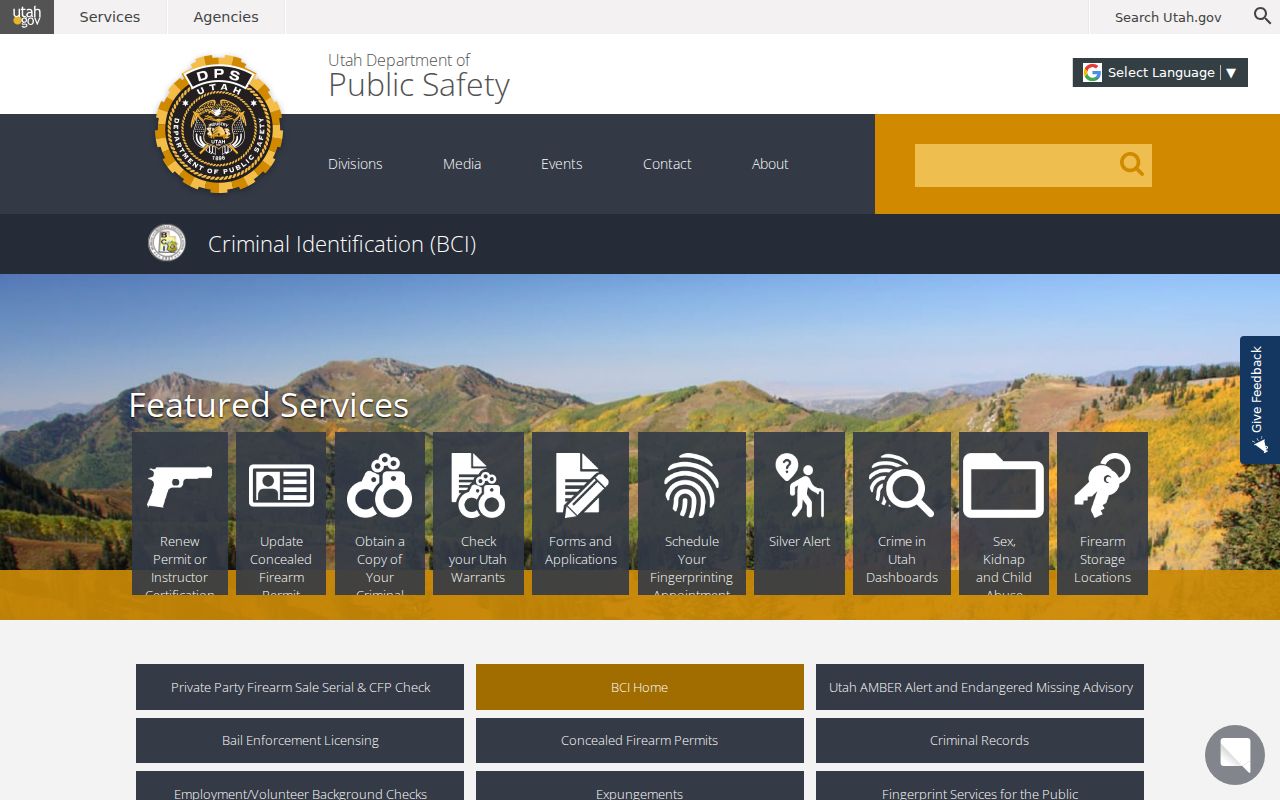
That division sends public case research to Xchange, current local custody research to county jails, and personal repository review to BCI. It also keeps a paid court index from being mistaken for a fingerprint-linked rap sheet.
Note: A Utah court name search and a Utah BCI Right of Access record answer different questions.
Inside the Utah Criminal History Repository
The Utah Department of Public Safety, Bureau of Criminal Identification is the central criminal-history repository. Utah Code §53-10-201 establishes BCI, and §53-10-202 sets its duties. The bureau runs UCCH, maintains computerized fingerprints, connects authorized checks with the Western Identification Network and FBI systems, supports UCJIS, audits participating agencies, compiles UCR and NIBRS data, and administers personal record review, challenges, and expungement work.
A UCCH record can include fingerprint-linked arrest cycles and later outcomes submitted by courts. It is a compiled identity history, not the full police narrative or court file. Public dissemination is restricted by Utah Code §53-10-108. The subject uses Right of Access, while an authorized justice or statutory program follows its own approved route. The specialized Utah BCI criminal records agency profile details the products, forms, and correction steps.
BCI's official overview documents the repository's fingerprint, crime-data, audit, and citizen-review work. The bureau sits between local creators and authorized users. It does not turn every county document into one public state file.
Utah Arrests Reach the Repository
A sheriff, municipal police department, Utah Highway Patrol unit, campus department, or other arresting agency creates the first record. If a reportable booking occurs, fingerprints connect that event to an identity transaction sent to BCI. Prosecutors then decide what to file. District and justice court clerks record pleas, dismissals, convictions, acquittals, and other outcomes. Utah law directs clerks to report specified dispositions to BCI within 30 days, while covered warrant status changes are due within one day.
Xchange updates from the courts' CORIS system when clerks enter an event. UCCH follows a separate matching path built around fingerprint identity and disposition reporting. The two sources can therefore diverge for a time. An old justice-court case may never have entered CORIS. A BCI arrest can remain when no public case was filed. Sealed or expunged cases leave the public Xchange view. When a disposition is wrong, correction starts with the filing clerk, then moves to BCI if UCCH still needs repair.
There is no published current statewide disposition-completeness percentage. BCI's database redesign and backlog goals show active quality work, but they do not support inventing a rate.
Utah Statewide Record Systems
Utah's main systems are separated by record type and government branch. BCI associates submitted arrests and outcomes with fingerprint identity. Utah Courts Xchange shows public CORIS case information, subject to exclusions and fees. UDC Offender Search covers people incarcerated by UDC or supervised by Adult Probation and Parole, but excludes unsentenced county-jail detainees. The Utah Sex, Kidnap, and Child Abuse Offender Registry publishes the statutory public subset of registry data.
The statewide systems below are starting points, not interchangeable reports. County agencies still hold the original arrest narratives, booking records, jail data, and court files.
| System | What It Holds | Run By |
|---|---|---|
| BCI Right of Access | Subject's fingerprint-associated Utah history | Utah BCI |
| UDC Offender Search | UDC incarceration and adult supervision | Utah Department of Corrections |
| Utah offender registry | Publicly publishable registry information | Utah BCI and DPS |
| Xchange Case Search | Public CORIS court case index and documents | Utah State Courts |
| Statewide Warrants | Qualifying Utah warrant name-search layer | Utah BCI and courts |
Utah Custody Records Split Three Ways
County jail, state custody, and federal custody require separate searches. A county roster answers who is held locally before trial or under a local sentence. UDC Offender Search covers Utah state incarceration plus adult probation and parole. The federal Bureau of Prisons locator covers federal prisoners. UDC expressly excludes unsentenced county-jail detainees, so an empty UDC result does not mean a recent booking did not occur.
The official UDC facilities source identifies two state prisons and six community correctional centers.
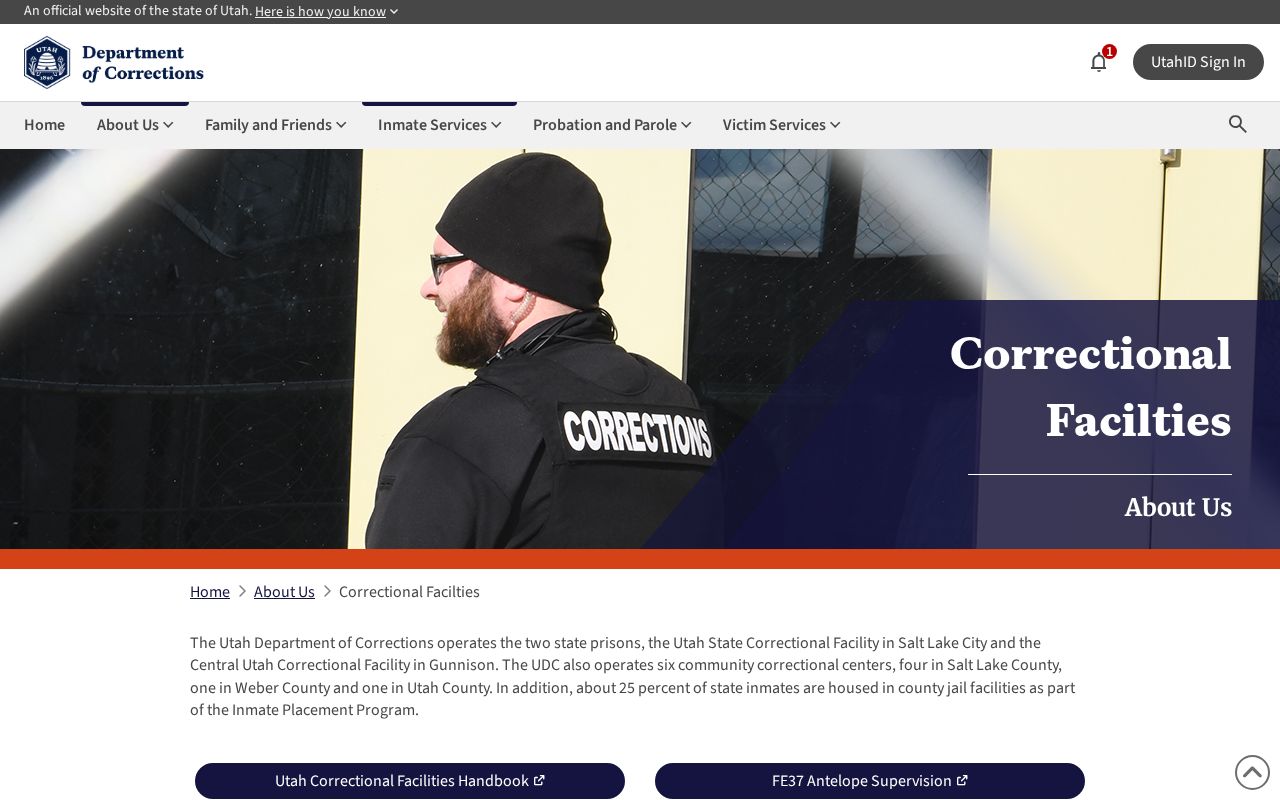
Utah's Inmate Placement Program adds one more wrinkle. About one-quarter of state inmates may be housed in contracted county jails while remaining UDC offenders. The legal custodian and the physical building can differ.
The UDC system overview reports about 6,300 incarcerated people, more than 15,000 under community supervision, and nearly 2,300 employees.
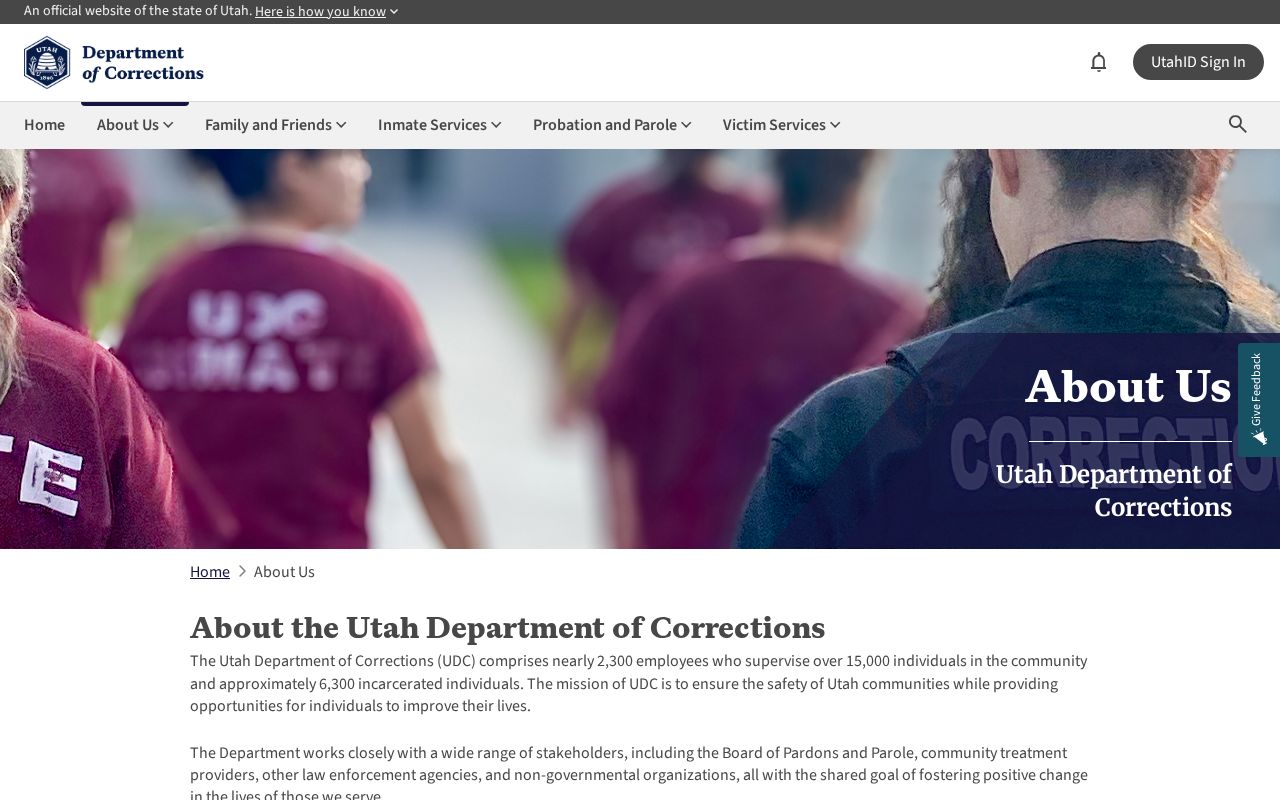
Those figures describe the state corrections system. They do not count every person held in a county jail.
Types of Utah Criminal Records
Each Utah criminal record has a creator and purpose. The agency report documents what officers observed and did. A county booking records intake and release. The prosecutor's complaint or information states filed allegations. A court docket tracks procedure and outcome. BCI compiles fingerprint-supported arrest cycles and reported dispositions. UDC and the Board of Pardons and Parole maintain custody and supervision records, while BCI now administers the statewide offender registry.
- Arrest and booking records: local police and county jails create the report, intake, charge, bond, and release entries.
- Criminal court case files: District and justice court clerks keep complaints, dockets, judgments, sentences, and public attachments.
- Repository history: Utah BCI's UCCH links submitted arrests and reported outcomes to fingerprint identity.
- Warrants: the issuing court records the warrant, while law enforcement maintains service and statewide justice-system entries.
- Custody and supervision: county jails, UDC, AP&P, and the Board each hold a distinct part of the record.
- Registry records: BCI publishes the subset required under Utah Code Title 53, Chapter 29.
A booking charge is not a conviction. A court file is not a rap sheet. Reading the source label first prevents the most common Utah record error.
Utah Warrant Records Need Confirmation
Utah publishes a free public layer for the Statewide Warrants file. It covers felony, class A, B, and C misdemeanor warrants plus qualifying traffic failure-to-appear warrants. The live app was blocked during research, so its current public field labels could not be confirmed. Do not infer public search controls from the more detailed identifiers visible only to law enforcement.
The official Utah Statewide Warrants gateway explains the free state search and warns about payment scams.
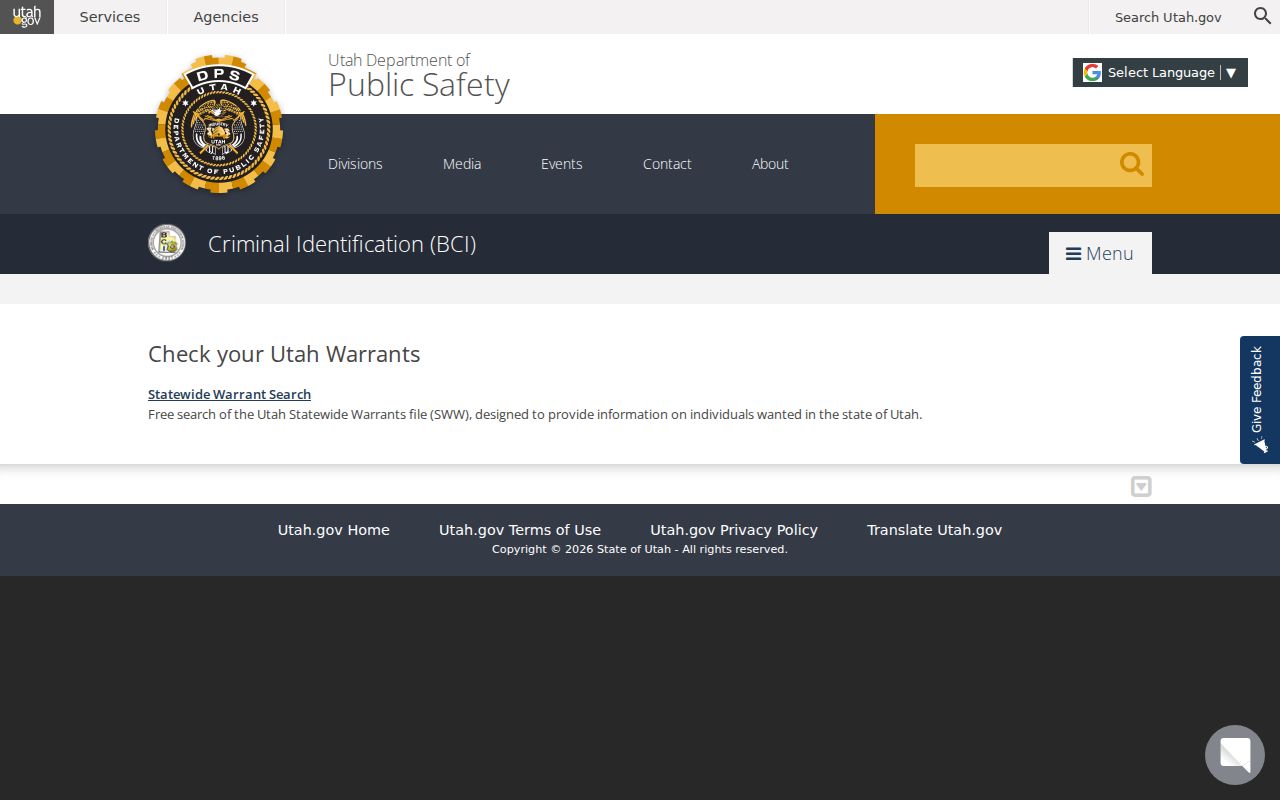
A possible hit should be checked against Xchange and confirmed with the issuing court or serving agency. To resolve one's own warrant, ask the court or qualified counsel about calendar, recall, surrender, or bail instructions before appearing. BCI does not call people to demand a warrant-fine payment.
Warrant caution: Never send money to an unsolicited caller claiming a Utah warrant can be cleared by immediate payment.
Utah Criminal Record Access Laws
The Government Records Access and Management Act, or GRAMA, classifies state and local records and sets request, fee, response, and appeal rules. It does not make restricted criminal-history information public. Utah Code §53-10-108 separately limits BCI dissemination while preserving a person's right to review and challenge their own record. Court rules define public and nonpublic case material. Expungement law and the registry statute add their own access boundaries.
The Utah Open Records Portal helps route requests to state and local custodians.
Use GRAMA for an existing public police or administrative record. It cannot force creation of a new report or bypass the statute that protects another person's UCCH history.
Key Statutes:
Utah Code Title 63G, Chapter 2 sets GRAMA classifications and request procedures.
Utah Code §53-10-108 limits BCI criminal-history dissemination and provides personal review and challenge rights.
UCJA Rule 4-202.02 identifies public and nonpublic Utah court records.
Utah Code Title 77, Chapter 40a governs petition and automatic expungement.
Utah Code §53-29-404 controls registry publication and forbids harassment, stalking, or threats.
The full GRAMA code publication supplies the controlling access framework.
The record holder still decides classification in the first instance and must identify the basis and appeal route for a denial.
Utah Expungement Changes Record Access
Utah uses petition-based expungement and Clean Slate automatic expungement. Eligibility depends on the complete statewide history, the outcome and offense, pending matters, sentence completion, waiting periods, and statutory exclusions. BCI evaluates eligibility for the petition route, but filing occurs in the court connected to the case or arrest. That county court enters the order. The person must then complete the service and verification steps required for BCI and other listed agencies.
The petition route begins with a fingerprint-supported BCI certificate application and a $65 application fee. BCI may take one to two months. If the record qualifies, conviction, plea-in-abeyance, and special certificates cost $65 each, while dismissal, acquittal, and declination certificates have no certificate fee. Court filing fees or a waiver may follow. An expungement challenge is different from a BCI error challenge: one restricts an accurate eligible record, while the other corrects bad data.
The Utah BCI expungement status and instructions describe certificate and Clean Slate processing.
After relief, a public Xchange case should disappear. MyCourtCase may show a generic expunged marker to the party, and a new personal BCI review can help verify repository treatment.
Utah Records Beyond Court Dockets
Probation, parole, police reports, and offense levels answer different parts of a Utah criminal history. Adult felony and class A probation plus parole supervision are mainly statewide through UDC Adult Probation and Parole. A court imposes probation. The Utah Board of Pardons and Parole decides conditional prison release, and AP&P supervises parole in the field. A probation violation returns to the sentencing court; a parole violation follows Board and UDC procedures.
Police narratives never flow into one statewide public report library. Send a GRAMA request to the sheriff, city police department, UHP, campus unit, or special agency that created the record. Include the incident number, date, location, involved party, and the exact material requested. Utah generally gives an agency up to ten business days for an ordinary request and five for a qualifying expedited request. Active investigations, victims, minors, medical facts, and security information may be withheld or redacted.
Offense class helps locate the court. Utah District Court hears felonies and class A misdemeanors. Justice courts generally handle class B and C misdemeanors, infractions, and local ordinance cases. A booked severity can change when a prosecutor files. Read the charging document and statute, not just the jail label.
| Utah Level | Ordinary Custody Range | Usual Trial Court |
|---|---|---|
| First-degree felony | 5 years to life | District Court |
| Second-degree felony | 1 to 15 years | District Court |
| Third-degree felony | 0 to 5 years | District Court |
| Class A misdemeanor | Up to 364 days | District Court |
| Class B or C misdemeanor | Up to 6 months or 90 days | Justice Court generally |
| Infraction | No ordinary incarceration | Justice Court generally |
Utah Criminal Record Fees
Statewide prices depend on the product. A fee for one system never buys the other records in the chain. The live agency page controls when an older PDF or registration panel conflicts with current published pricing.
| Utah Record Channel | Official Base Fee |
|---|---|
| BCI Right of Access | $20 |
| BCI record challenge | $20 |
| BCI fingerprint service | $20 |
| FBI personal Identity History Summary | $18 direct |
| Xchange one-time or guest use | $10 initial credit |
| Xchange subscription | $25 setup plus $40 monthly |
| BCI expungement certificate application | $65 |
Xchange's information page states $0.35 per search and $1 per document, while part of the live registration flow has shown $0.20. Verify at checkout. Local fingerprint capture, certified copies, GRAMA labor, media review, and county services can add separate charges.
Criminal Records by County in Utah
Arrest reports, booking entries, jail rosters, and official trial-court files begin at the local level. Choose the county of arrest or filing instead of treating a statewide result as the complete record. Utah's largest record environments include Salt Lake, Utah, Davis, Weber, Washington, and Cache counties, but all 29 county sites route readers to their own sheriffs, police agencies, and courts.
The official Utah Online Library county profiles confirm the statewide county list and local seats.
The county cards below point to the local record hubs. Their raw subdomain slugs match the live folder names.
Salt Lake County
Salt Lake City · Utah's largest metro record environment
Utah County
Provo · major Fourth District and municipal court network
Davis County
Farmington · large jail and Second District caseload
Weber County
Ogden · northern metro courts and county corrections
Washington County
St. George · growing Fifth District record network
Cache County
Logan · northern sheriff, jail, and First District hub
Browse the full directory of all 29 Utah counties to open the criminal records site for any county.
Utah Criminal Records Keep Changing
Utah BCI dates its centralized fingerprint work to 1927. Today, the bureau operates UCCH, fingerprint systems, UCJIS audits and training, UCR and NIBRS collection, record challenges, and authorization-specific state and federal channels. Utah required all-NIBRS reporting in 2021 and launched interactive Crime in Utah dashboards in 2022. The 2024 report received NIBRS data from 137 agencies, covering 98.14% of Utah's population. Those are reporting measures, not arrest or conviction totals.
Corrections changed in 2022 when more than 1,600 incarcerated people moved from the old Draper prison to the Utah State Correctional Facility over five days. Registry administration transferred from UDC to BCI in July 2024, then the controlling registry law moved to Title 53, Chapter 29 in May 2025. Clean Slate processing also went through a special request window from October 2024 through January 1, 2026. Dates matter because older pages can name the wrong administrator or process.
The official UDC annual report archive documents the corrections system and the 2022 prison-move context.
BCI's July 2026 strategic plan targets a criminal-history database redesign by the end of 2027 and an identified backlog by the end of 2026. Those goals support checking the newest official source and verifying any disputed entry with its creator.