
Utah Arrest History
A county sheriff, municipal police department, Utah Highway Patrol unit, campus agency, or special district police force can create a Utah arrest record. The arresting agency writes the incident report and probable-cause account. If booking follows, the county jail records the intake, fingerprints, booking charges, bond, custody events, and release. The prosecutor then decides whether to file a court case. Those are separate acts, held by separate offices.
A qualifying fingerprint-supported Utah arrest can also reach the Utah Department of Public Safety, Bureau of Criminal Identification. BCI associates the Utah arrest cycle with the person's Utah Computerized Criminal History file and later matches a court disposition when one is reported. The same Utah event can therefore appear as a police report, jail booking, Xchange court case, and UCCH entry. Each source answers a different question, and none should be read as the whole Utah arrest history by itself.
Four Utah Arrest Record Channels
The best Utah channel depends on the arrest record stage. A police report describes what officers recorded. A Utah county jail roster answers current or recent custody. Xchange shows what a prosecutor filed and how the court acted. BCI Right of Access shows the fingerprint-linked Utah history belonging to the requester. There is no single public Utah name search that merges all four.
| Utah source | What it answers | Main limit |
|---|---|---|
| Arresting agency | Incident, arrest, and probable-cause report | May omit the later filing and outcome |
| County jail | Booking, bond, custody, and release | Retention and public fields vary by county |
| Xchange | Public filed case and court disposition | No arrests that were never filed |
| Utah BCI | Requester's fingerprint-associated UCCH history | No general public search for another person |
Use GRAMA with the office that created an existing public record. Active investigations, victim data, juvenile material, security facts, and restricted criminal-history information may be withheld or redacted. GRAMA cannot force BCI to release another person's UCCH history, and it cannot require an agency to create a new report.
Note: Pick the Utah source by record stage instead of expecting one arrest search to contain every document.
How Utah Arrests Reach the Record
The Utah record chain starts at the arrest. A Utah booking creates fingerprints and a local custody event. A qualifying submission then travels to BCI, where it becomes a UCCH arrest cycle. If the prosecutor files, the Utah court creates a case in CORIS. The final court result must be matched back to the BCI cycle. A dismissal, acquittal, plea in abeyance, or conviction can therefore arrive after the Utah arrest is already visible in another system.
Data flow: Arrest › Booking › Fingerprint Submission › Utah BCI › Disposition Reporting
Gaps can occur. A Utah citation release may not include fingerprints. A disposition may be late or fail to match due to variant identity data. Older Utah court records may predate an electronic conversion. An arrest that was never charged can remain in a legally accurate Utah repository history until correction or expungement rules apply. Check the creator of each record before deciding which correction route fits.
Note: A blank disposition can reflect delayed reporting, so compare the Utah court file before seeking a BCI correction.
Utah Arrest Data Coverage Gaps
BCI's Crime in Utah Dashboards collect local data under national UCR and NIBRS rules. Utah agencies have been required to report NIBRS since 2021, and BCI launched the interactive dashboards in 2022. The 2024 report received NIBRS data from 137 agencies. That represented 95.13% of Utah agencies and covered 98.14% of the state's population. Some military, national park, and tribal agencies may report directly to the FBI instead.
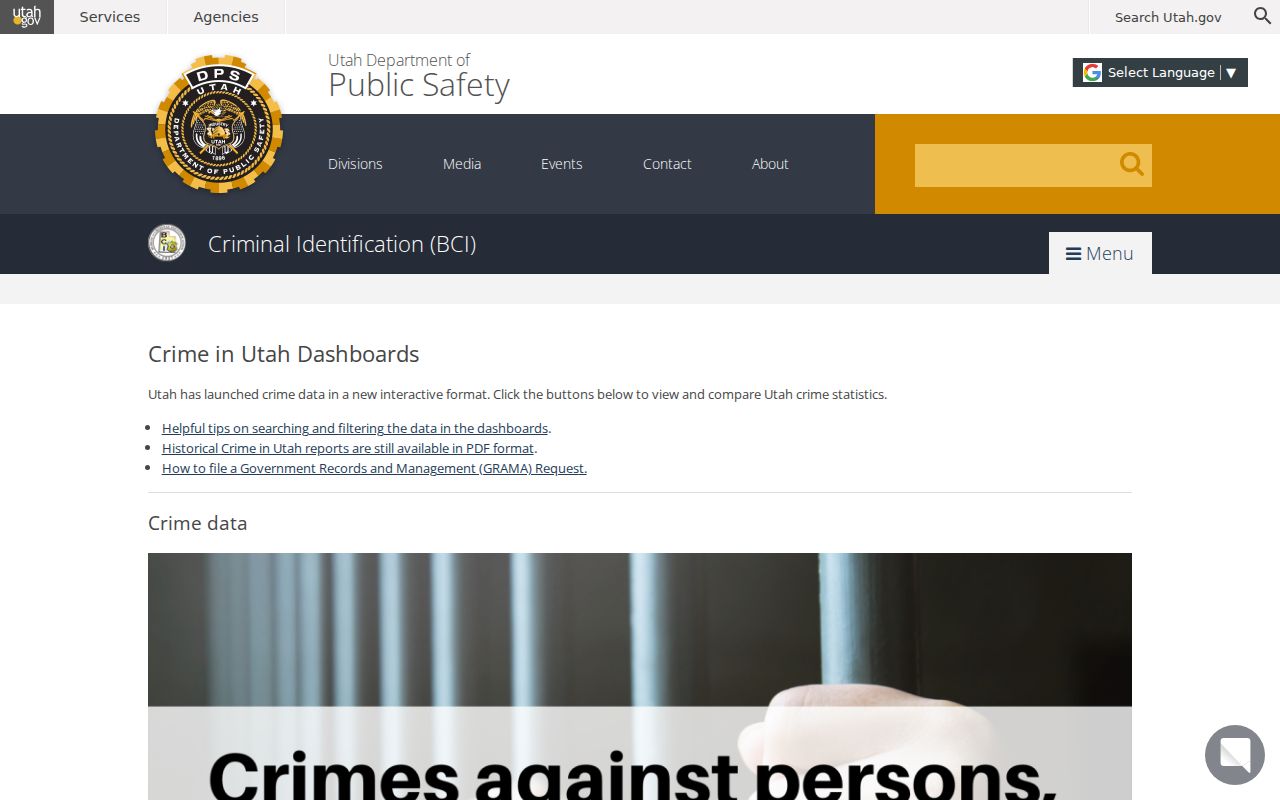
The dashboard is useful for statewide patterns, but its totals are statistical data rather than a list of named Utah arrests.
The official 2024 Crime in Utah report page supplies the latest located annual context for reporting coverage and offense counts.
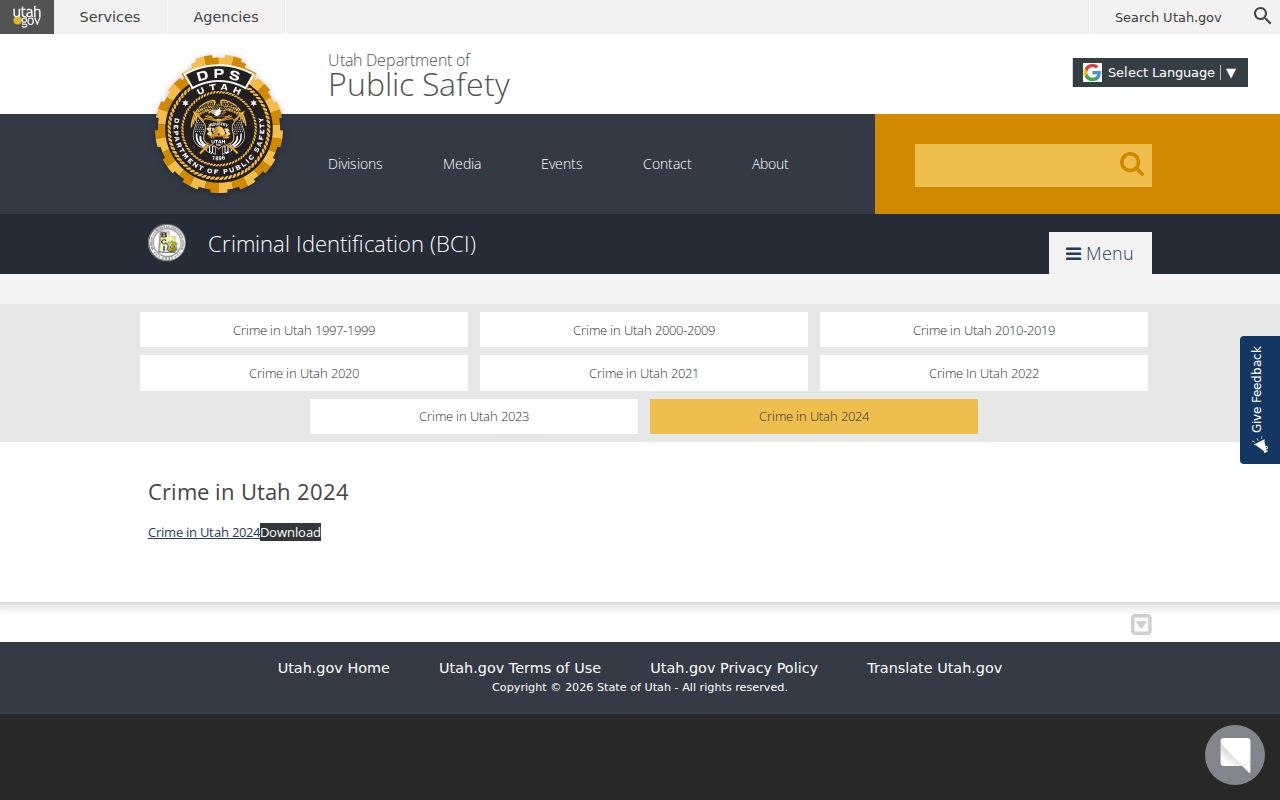
The report counted offenses, not convictions or unique people. It did not publish one clean total-arrests figure, so an offense count should never be presented as Utah arrests.
Looking Up Arrests in Utah
A recent Utah arrest usually appears at the county layer before a Utah court or state system. Start with where the event happened and which agency made the arrest. A Utah county roster may remove a released person quickly. A police report can remain unavailable while an investigation is active. Xchange begins to matter after the prosecutor files. BCI Right of Access is reserved for review of one's own fingerprint-associated Utah history.
- Identify the likely Utah county, date, and arresting agency.
- Check that county sheriff's current prisoner channel or jail information line.
- Request the officer's report from the arresting agency under GRAMA, using the date, location, name, and report number if known.
- Search Utah criminal court cases after prosecutors have had time to file.
- Use BCI Right of Access for one's own Utah repository history and challenge errors with source documents.
- Check UDC after a state commitment or when Adult Probation and Parole supervises the person.
Browse the directory of all 29 Utah counties for the jail, sheriff, police, and local court routes. No filed Xchange case may mean the filing is not ready, prosecutors declined, the search used the wrong name or court, the case predates CORIS, or the matter is restricted. It does not prove that no arrest occurred.
Note: Recent Utah booking details often disappear from a jail roster sooner than the agency's underlying arrest report.
Utah Booking Images Stay Protected
Utah does not treat every booking photograph as an automatically public mugshot. Utah Code §17-72-802 and GRAMA §63G-2-305(80) protect booking images unless a statutory condition applies. Release may follow a conviction based on the conduct for which the person was jailed, or another law-enforcement or judicial exception. A requester may have to sign a statement that the image will not be placed on a publish-for-pay site.
Utah Code §17-72-802 sets the booking-image release and publish-for-pay restrictions.
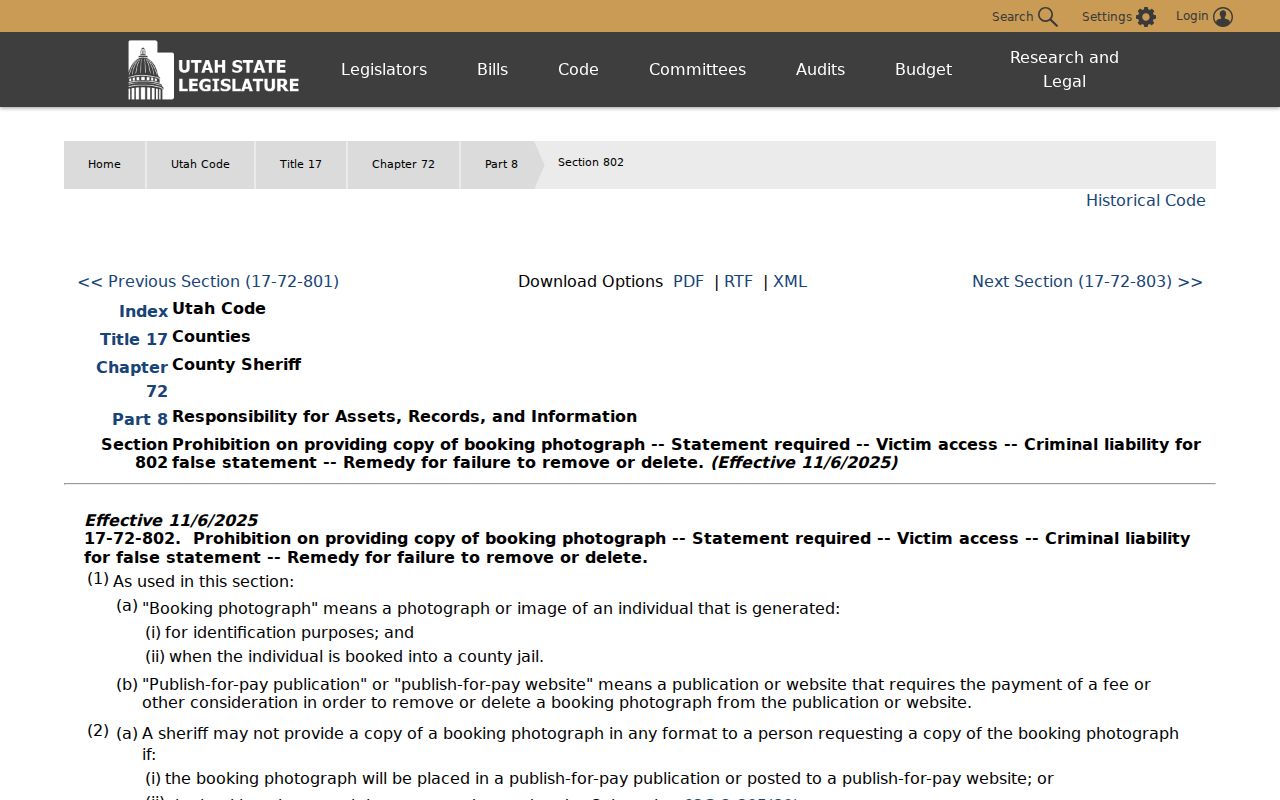
The statute also creates duties tied to proof of acquittal, nonprosecution, expungement, vacatur, or pardon. The public record should be requested from the lawful Utah custodian, not copied from a mugshot aggregator.
Inside a Utah Arrest Record
A Utah arrest record may combine incident fields with booking and custody fields. Public versions omit full identifiers and protected data. The booked charge reflects the arresting officer's basis at intake. Prosecutors may later file a different charge, reduce it, or decline the case. Bail and court fields can also change after the first jail entry.
| Name and Identifiers | Name, limited descriptors, and agency or booking identifiers, with protected data redacted. |
|---|---|
| Arrest Event | Date, time, place, arresting agency, and agency case number. |
| Probable Cause | Statutory basis and officer account, subject to investigation and victim redactions. |
| Booking Charges | Allegations recorded at intake, not the final filed counts. |
| Custody Fields | Booking number, intake, housing, release, and scheduled court where available. |
| Bond or Bail | Type, amount, conditions, and release method when public. |
Fingerprint transaction data can link the booking to a UCCH arrest cycle. Utah's SID and transaction identifiers help prevent name-only mismatches. A public jail roster will not show all of that repository data. Likewise, a BCI Right of Access report does not reproduce the full police narrative or every court paper.
Utah County Jail or UDC
County jails hold many people awaiting trial and people serving local sentences. The Utah Department of Corrections holds or supervises people committed to the state system. UDC Offender Search expressly excludes unsentenced people in county jail. Yet physical location can be less simple after sentencing. Utah's Inmate Placement Program houses about 25% of state inmates in contracted county jails, so a UDC offender may be located in a county facility.
UDC Offender Search accepts a first and last name or an offender number and separates state custody from a recent county arrest lookup.
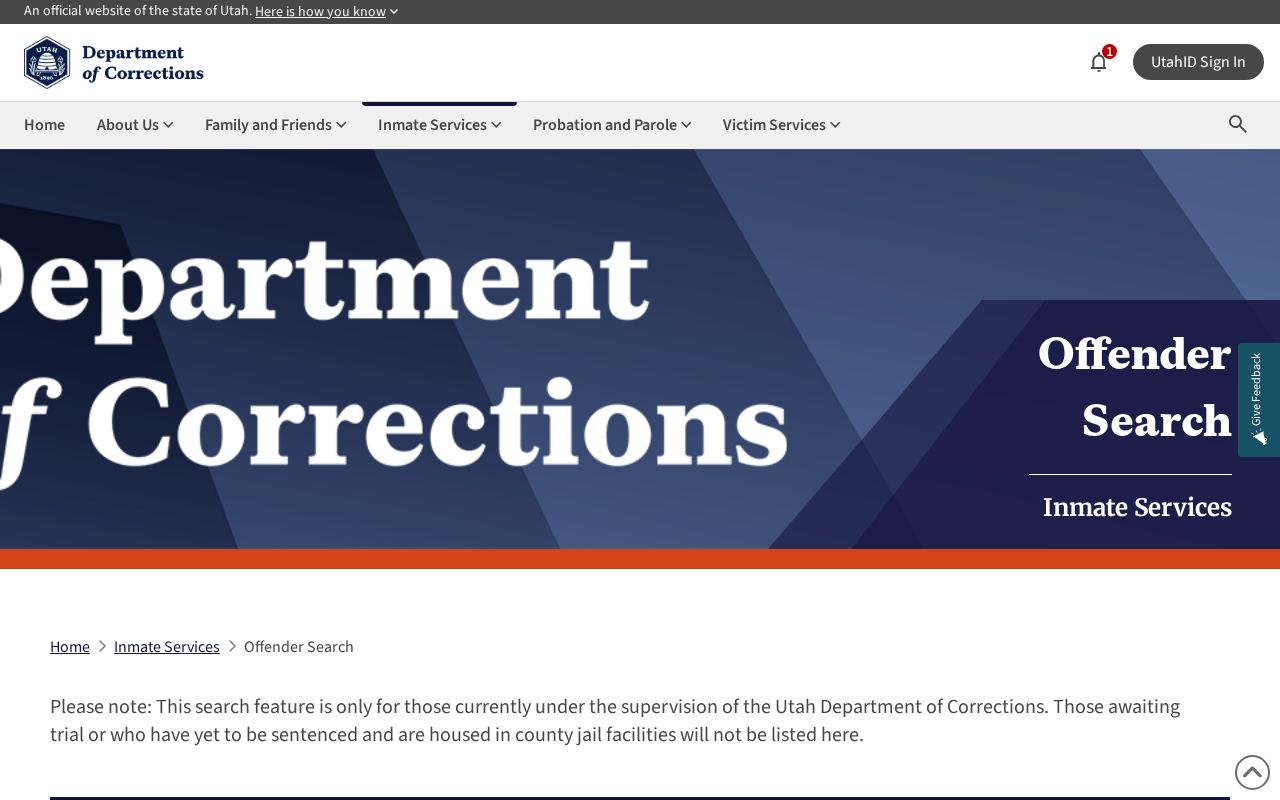
Observed details include offender number, name, date of birth, location, housing facility, release date or type, and case-manager information. The public result did not show a photograph, conviction charges, sentence detail, committing county, or custody level.
Note: A county facility can house a state-sentenced Utah offender, so status and physical location are not always the same.
Utah VINE Custody Alerts
UDC runs VINE for custody notifications. It can report prison release, escape, return from escape, death, parole release dates, and transfers among prison sites, participating county jails, and community correctional centers. VINE should not be the only part of a personal safety plan.
Utah UDC's victim notification page describes free VINE registration by phone or online and the custody events it can send.
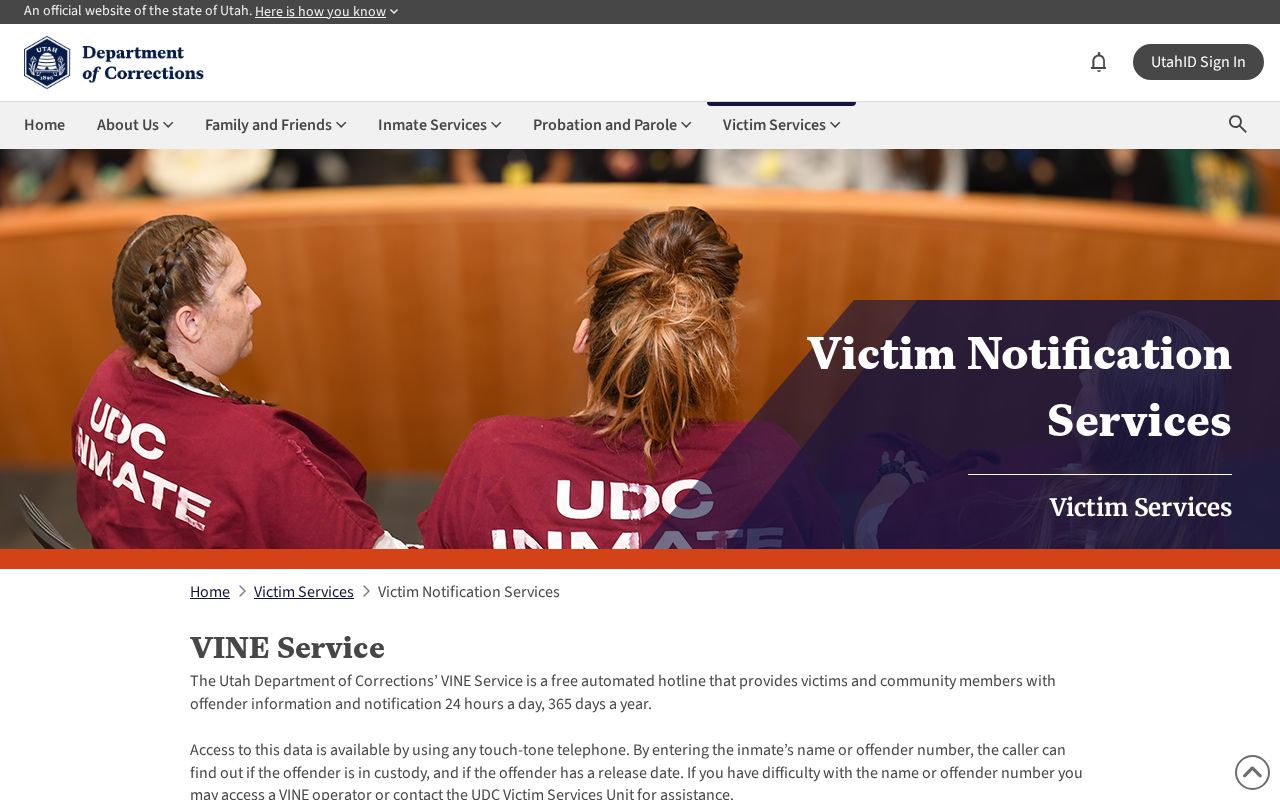
VINE adds notice to a Utah custody search, but it does not replace direct confirmation with the jail or UDC when timing matters.
Correcting a Utah Arrest Cycle
Start with the source that owns the disputed fact. Ask the arresting agency about an error in its incident report. Contact the filing court clerk if Xchange shows the wrong charge or outcome. For an error in one's own UCCH history, BCI provides a $20 challenge process that requires fingerprints and official evidence. An identity mismatch, missing disposition, or wrong charge needs source papers, not a broad request to erase accurate data.
Expungement is different from correction. Utah's petition and Clean Slate processes restrict qualifying legally accurate records. Eligibility depends on the full history, case outcome, excluded offenses, pending matters, completion of sentence or supervision, and waiting periods. A petition follows the court tied to the case or arrest. BCI evaluates statewide eligibility, while the correct Utah court enters the order.
Arrests vs Convictions in Utah
An arrest is an accusation event. A conviction is a court judgment after a guilty plea or adjudication. Utah records preserve that split. The jail may show the booked charge before a prosecutor acts. Xchange may later show dismissal, acquittal, a plea in abeyance, or conviction on only some counts. BCI may hold the fingerprint-supported arrest and a reported disposition. Never turn a Utah arrest entry into a claim of guilt.
| Question | Utah arrest record | Utah conviction record |
|---|---|---|
| Created by | Arresting agency and booking jail | Court judgment, then reported to BCI |
| What it shows | Custody, booked allegation, bond, and release | Guilt on a particular count and the sentence |
| Best source | Agency report and county jail record | Official Utah court file |
| Public access | GRAMA classification and redactions apply | Public Xchange data unless restricted or expunged |
| Relief route | Correction for error; expungement if eligible | Utah expungement only when statutory rules are met |
Note: A Utah arrest with no listed disposition is not proof of guilt; confirm the outcome with the filing court clerk.