
Criminal Court Cases in Utah
Utah uses two trial-court levels for most criminal filings. The Utah District Court has general jurisdiction over felonies and class A misdemeanors. It also conducts felony preliminary hearings, trials, sentencing, and post-conviction work. A Utah Justice Court hears class B and C misdemeanors, infractions, and local ordinance violations within its territory. Utah does not place those cases in a separate municipal-court tier. Municipal prosecutions go to the justice court that serves the city when that court has jurisdiction.
The clerk of the filing Utah District or justice court keeps the official Utah criminal case record. CORIS, the Utah courts' case-management system, sends public entries to Xchange. That statewide view is useful, yet it is not a certified Utah court file. An appeal usually moves from a Utah trial court to the Utah Court of Appeals, with review by the Utah Supreme Court in assigned matters or when certiorari is granted. Each Utah court level creates its own orders and docket history.
Utah Court Levels and Charges
The charge class points to the likely Utah court. Felony and class A allegations belong in District Court. Class B and C misdemeanors, traffic cases, and infractions usually begin in a justice court. A qualifying justice-court matter can receive a trial de novo in District Court. That means the District Court conducts a new trial instead of merely reading the lower court record.
| Utah court | Criminal work | Record clue |
|---|---|---|
| Justice Court | Class B and C misdemeanors, infractions, local ordinances | Older pre-CORIS cases may be absent from Xchange |
| District Court | Felonies, class A misdemeanors, preliminary hearings, sentencing | Most courts used CORIS by the end of 1998 |
| Court of Appeals | Most criminal appeals | Appellate docket and opinions are separate from the trial file |
| Supreme Court | Final state review in matters within its jurisdiction | Review may depend on an accepted petition |
A case number is not unique across all Utah courts. The Utah court location helps identify the right file. Case type codes also matter. Xchange lists codes such as FS, MD, MO, IF, NA, and TC. Read the Utah court, location, case type, and party details together before treating a match as the intended Utah case.
Note: A Utah case number may repeat in another court, so pair it with the court location before requesting records.
Searching Xchange Case Search: Repository of Court Records
Utah Courts' Xchange overview explains access to the statewide repository, its reference material, and public case tools.
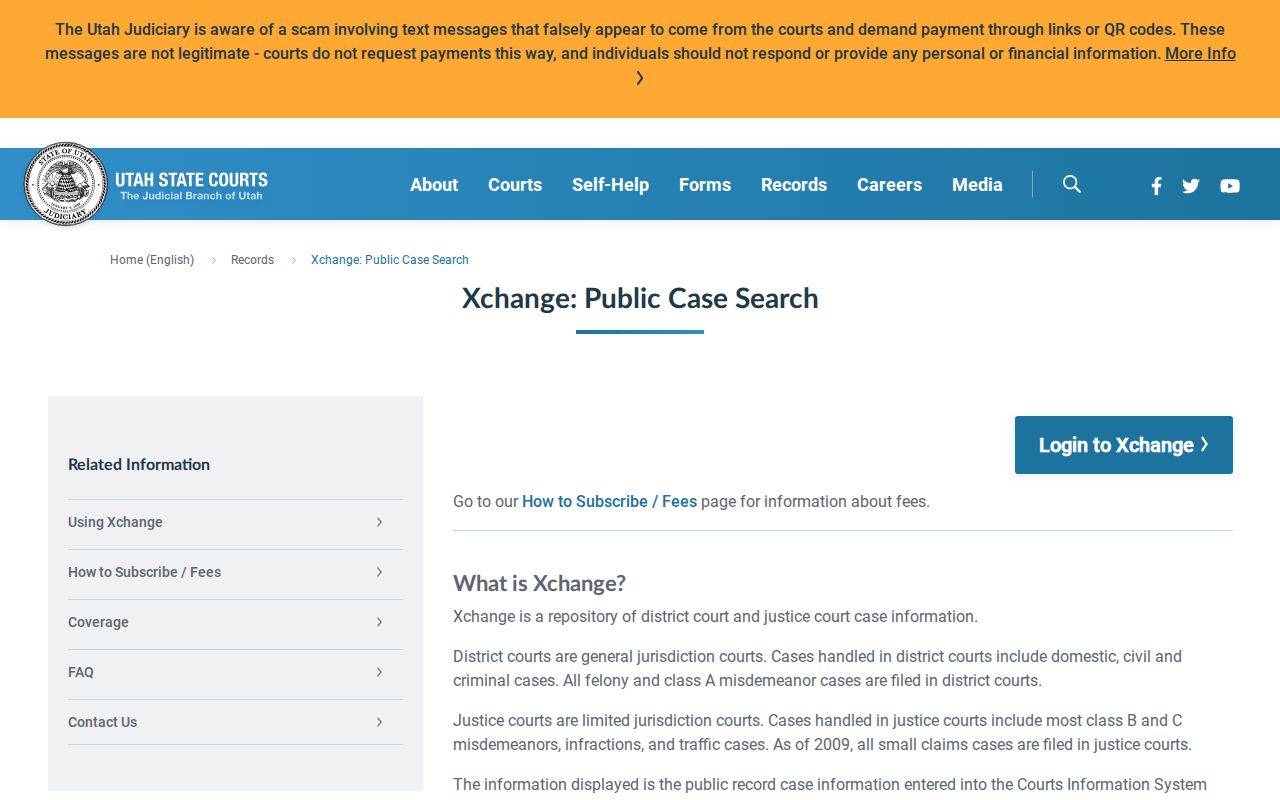
The overview places Xchange in its proper role: it is a broad public index and document channel, while the filing clerk supplies certified Utah court records.
- Open Xchange and choose a one-time session or subscription account.
- Search Utah records by name, case number, or another available identifier.
- Narrow results by Utah county, Utah court location, case type, or date range.
- Review charges, hearings, judgment codes, and disposition entries for the correct case.
- Ask the filing Utah court clerk for the docket, charging paper, judgment, or a certified copy when official proof is needed.
The official Xchange registration interface shows account choices, email verification, guest access, and payment controls.
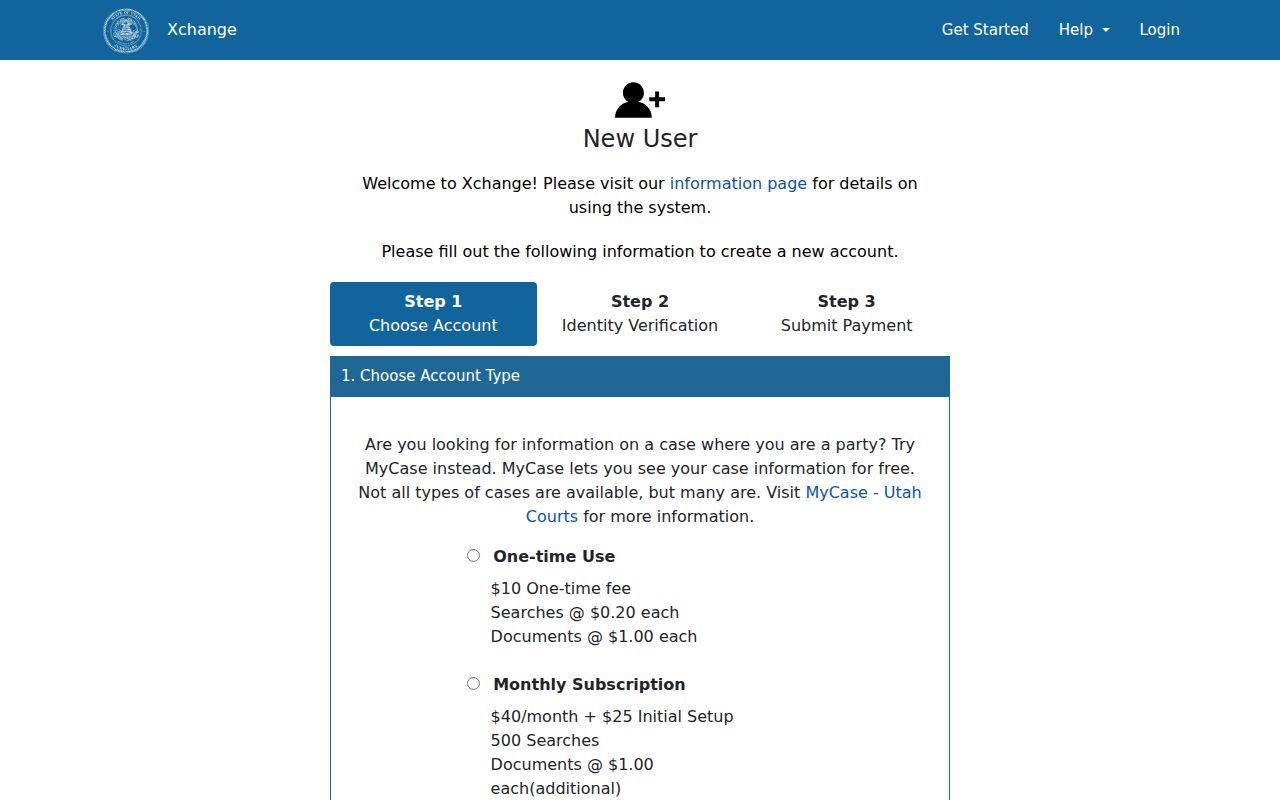
A guest session lasts 24 hours, can end after 30 minutes idle, and loses unused credit when closed. That makes careful search preparation useful.
| Field label | Type | Required | Utah Xchange behavior |
|---|---|---|---|
| Jurisdiction | Selector | Unspecified | District Court, Justice Court, or both |
| Case Number | Text | Optional | Not unique statewide; add location |
| Last Name/Company | Text | Search-dependent | Exact unless a wildcard is used |
| First Name | Text | Optional | A trailing * can catch middle-name variants |
| Case Type | Selector | Optional | Uses official Utah case-type codes |
| Search Scope | Selector | Optional | Statewide, county, or a court |
| Birth Date | Date | Optional | Useful for a criminal defendant match |
| Date Range | Control | Optional | Filing and disposition ranges narrow results |
Utah Xchange Fees and Limits
A one-time or guest user starts with a $10 deposit. Utah Courts currently describes searches at $0.35 and documents at $1. A registration panel has also displayed $0.20 during part of the workflow, so the amount shown at checkout should control. A monthly account has a $25 setup fee and costs $40 per month. It includes 500 searches, then charges $0.35 for each added search. Documents remain $1.
Utah Courts' Xchange subscription page publishes the current account, search, and document price structure.
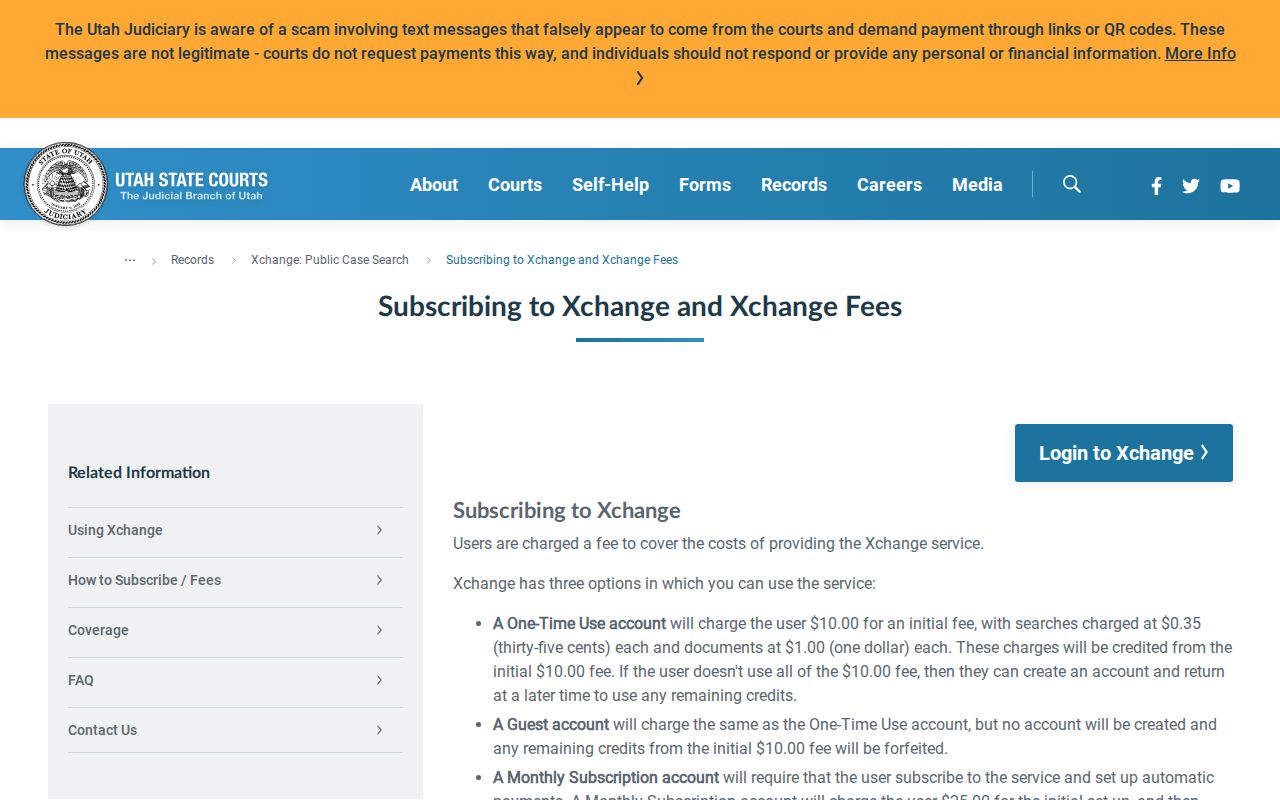
The price page helps distinguish a billable Utah Xchange click from a Utah clerk's separate copying or certification charge.
Utah Xchange returns no more than 500 results. A common Utah name can reach that cap fast. Add the county, Utah court location, filing range, disposition range, case type, and birth date when available. Middle-name handling can also shift results. Free Xchange access is available at Utah District courthouses and may be offered at designated public terminals, though certified copies still come from the clerk. Note: Each search click can be billable, so choose the narrowest useful Utah criteria before submitting a query.
Inside a Utah Criminal Case File
A Utah court file tracks procedure count by count. It may show several charges with different outcomes. One count could end in conviction while another is dismissed. The docket can also show a warrant without proving it remains active. Read the latest recall, satisfaction, or disposition entry and confirm status with the issuing court.
| Case Number and Court | Identifies the filing, court location, county, and case type. |
|---|---|
| Charging Documents | States filed allegations, Utah Code citations, and severity for each count. |
| Docket Entries | Lists filings, orders, hearings, warrants, pleas, and other court events. |
| Parties and Counsel | Names public parties, attorneys, and the assigned judge, subject to redaction. |
| Disposition | Shows the outcome of each count, such as conviction, dismissal, or acquittal. |
| Sentence and Judgment | Records custody, probation, fines, fees, restitution, and court orders. |
Protected addresses, full personal identifiers, victim and minor names, and nonpublic documents are removed or redacted. Juvenile Court matters, sealed cases, expunged cases, adoptions, civil mental-health commitments, and criminal NA matters are excluded from public Xchange under Utah court access rules.
Reading Utah Judgment Codes
Short codes compress key events in a Utah case history. BO means bound over. CS marks a Utah criminal sentence. D and DI indicate dismissal without or with prejudice. DP means declined prosecution, while DV indicates diversion. Guilty variants include G, GB, GJ, and GP. NB and NJ mean not guilty after bench or jury trial. PA and PB mark a plea in abeyance. A code is one piece of the Utah record, not a safe substitute for the full docket.
Utah Courts' Xchange case reference links the official case-type and party-type code material used to read results.
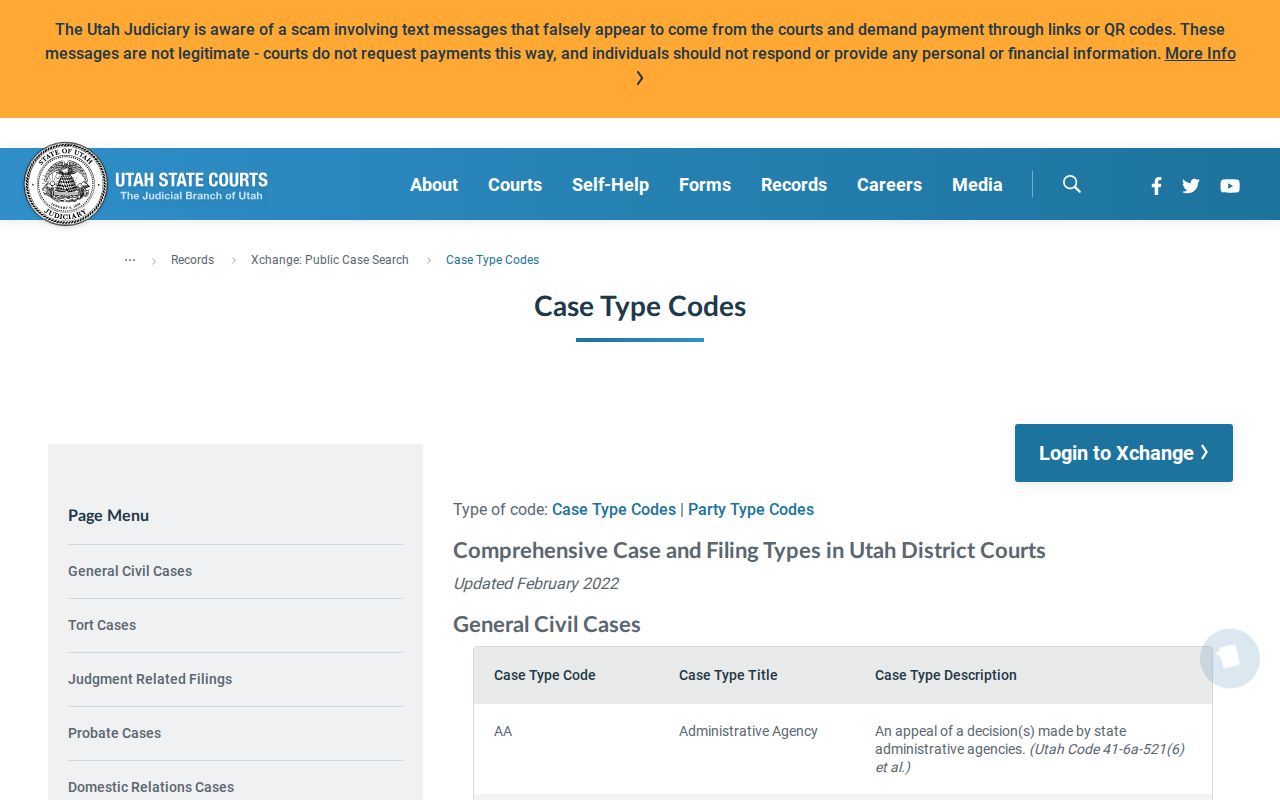
The reference tables reduce guesswork, especially where the same Utah docket contains several parties, charge sequences, and judgment entries.
- Disposition
- The result of a charge, such as conviction, dismissal, or acquittal.
- Bindover
- The transfer of a felony matter after probable cause is found or the hearing is waived.
- Plea in abeyance
- A Utah agreement that holds a plea while conditions are completed, potentially followed by dismissal.
- Expunged
- A qualifying record restricted under Utah law after a court or automatic Clean Slate process.
How a Utah Criminal Case Moves
A Utah criminal record grows in stages. Police first create arrest or citation material. A Utah prosecutor then decides whether to file a complaint or information. A felony may proceed through a preliminary hearing and bindover unless that hearing is waived. Arraignment sets the plea. Motions, discovery, negotiations, and pretrial hearings follow. Each count ends through a plea, dismissal, or trial result. The Utah judge then enters judgment and sentence when guilt is established.
Case flow: Charges Filed › Arraignment › Pretrial › Plea or Trial › Disposition › Sentencing
The court file is not a BCI rap sheet. Xchange shows the Utah case process and public documents. Utah BCI's UCCH record associates fingerprint-supported arrest cycles with reported outcomes. A delayed or unmatched disposition can leave the two systems out of step. Correct a court entry through the filing clerk. Challenge an error on one's own UCCH history through BCI with fingerprints and source documents.
Note: Review each count separately because a single Utah criminal case can end with several different dispositions.
MyCourtCase for Your Utah File
MyCourtCase is a free option for a party who needs an eligible Utah case of their own. It is separate from paid Xchange. After identity checks and case linking, a party can view supported case history and papers, make payments where offered, and use features tied to that case. It does not provide a public search for other people's court records, and some case types are not supported.
The official Utah MyCourtCase service page describes party access and the functions available after a case is linked.
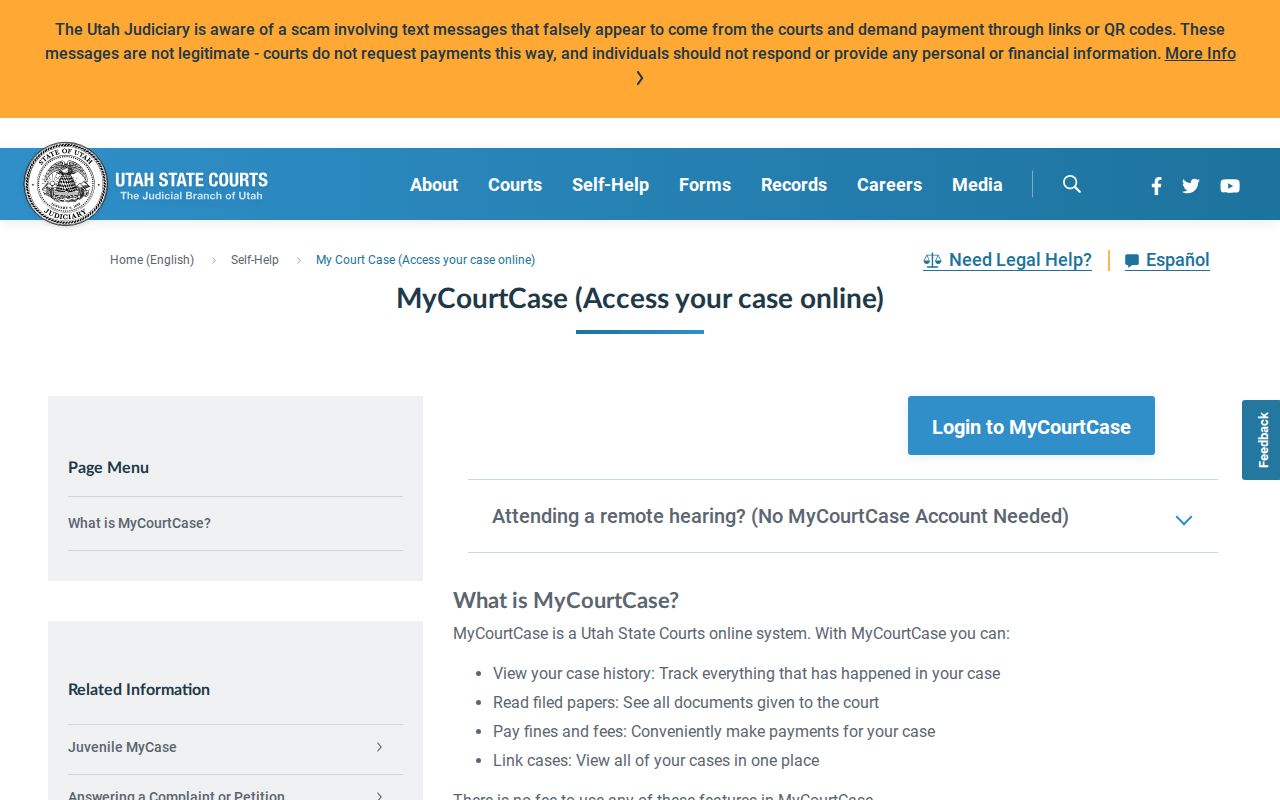
MyCourtCase can be the best first stop for one's own file, while Xchange serves broader public docket research and the clerk supplies certified records.
When Utah Xchange Is Wrong
CORIS entries appear in Utah Xchange quickly, but an entry may still be incomplete or linked to the wrong outcome. First open the full Utah event history. Check whether the case has several counts. Compare the case number, Utah court, date, and party details. Then contact the clerk for the Utah court where the case was filed. Xchange is a repository view, so its support channel cannot replace the official keeper's correction process.
The official Xchange FAQ documents the 500-result limit, CORIS coverage, and categories that do not appear.
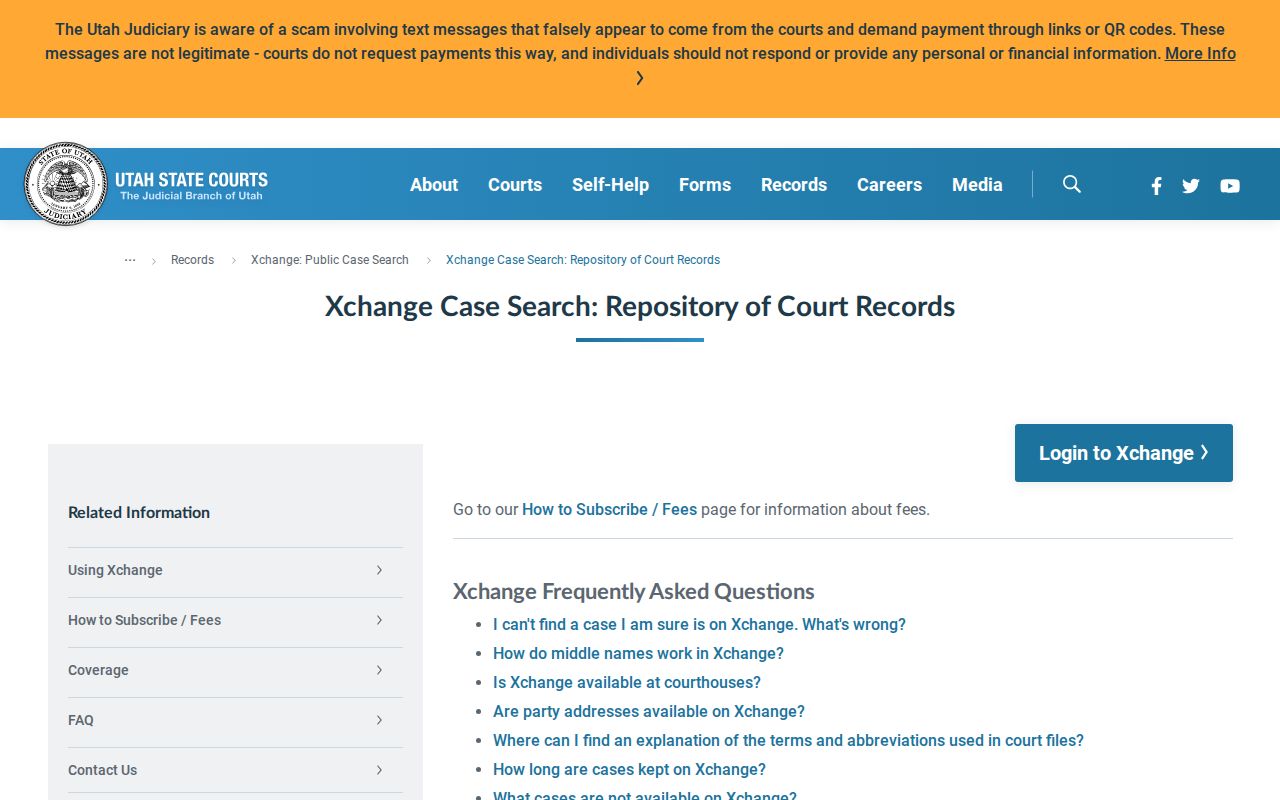
The coverage rules explain why an older justice-court file, a juvenile matter, or an expunged Utah case can be absent without being a search error.
Case Records at the County Level
The complete Utah case file stays with the clerk of the court that heard it. Use the filing county when requesting the complaint or information, docket, minute entries, judgment, sentence, and certified copies. A justice-court file may need a direct clerk request if it predates that court's CORIS conversion. Xchange can point to the right court, but the county record is the source for official documents.
Browse the directory of all 29 Utah counties to reach the right local records route. The court file should also be read separately from an Utah arrest record. A booking charge reflects the intake event. The later Utah court filing and disposition show what prosecutors pursued and how each charge ended.
Note: Search results identify possible Utah cases; certified records from the filing clerk establish the official contents and outcome.